Search options
Cancel


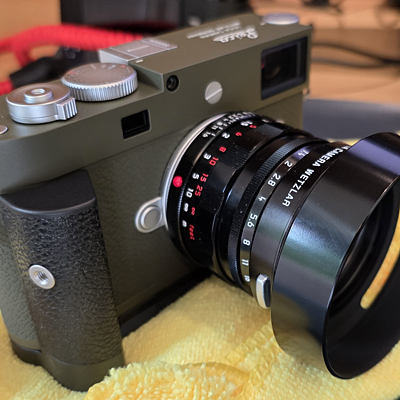
 With that said, I have a confession to make, and I’m not going to sugarcoat it to sound like a purely analytical gear reviewer. I review and focus on the experience rather than the technical details, charts, or edge sharpness across the frame. I originally bought this glossy black version of the Leica 50mm Summilux from PopFlash because of how it looked.
  Guest Guest

Support LeicaImages.com — Our community is free for everyone. If you value what we do, you can help cover our server and development costs with a small one time or monthly donation.


I set this shot up right at my dining table, focusing wide open at f1.4 directly on the textured area of the monstera's center stem. The way this lens handles the scene is just phenomenal.
Look at that center stem. The focus is incredibly crisp right on the textured rind of the plant. Even at 1.4, the lens delivers more than enough micro contrast and detail to make the subject just pop. No question about it, the asperical version will have better contrast and sharpness. But, this is way better than what I was expecting. A little of both. The classic glow and modern sharpness. I love it!!
Call me a bokeholic, But, the real magic here shines when you look past the monstera to judge the bokeh. Backgrounds like this, filled with sharp edges from hanging picture frames and a bright point of light are usually a nightmare for modern lenses. A clinically perfect lens would often render those frame borders with harsh, nervous, double lined edges. Instead, this classic Lux melts them away completely. Wow !!!
Have a look HERE for a similar shot with a slower apo lens and you will see what I mean.
OMG I love this lens!
Here is a completely different kind of test for the lens, and it absolutely delivers. This is a classic lifestyle snapshot from the comfort of my living room, featuring my size 13 shoes kicked up in the immediate foreground and my trusty model Freya hanging out in the background. You gotta love Freya. She is in so many of my pictures without complaining!
For this shot, the precise focus point was the cluster of leaves sitting at the very top of the plant on the table tray. What this image demonstrates about the classic lens rendering in black and white is incredible.
This frame is an excellent example of depth separation. A modern lens often gives you an artificial, cutout effect where the subject feels unnaturally separated from its surroundings. Here, it renders a beautiful, gradual depth that feels entirely natural.
My shoes in the foreground are completely out of focus, yet they have a soft, shape that frames the right side of the image without becoming a distracting dark blob as my wife would call the. On the other side, the diffuser sticks and glasses on the table tie the scene together, leading your eye right to the critical plane of focus which really stands out.
When you look closely at that top cluster of leaves where the focus lands, the sharpness is stunning considering this lens is supposed to be softish wide open. The lens resolves the delicate edges of those tiny new leaves with wonderful contrast. The black and white rendering brings out the rich tones as they transition across the foliage, showing that this summilux does not hold back where it matters most.
Then there is the background. Freya is resting back there, perfectly recognizable yet beautifully softened by the 1.4 depth of field. Even with the fireplace to her right, the electronics, and the large TV behind her, the background never gets busy or nervous. The lens simply melts the room away allowing the central tabletop scene to stand out.
I can see why people appreciate this type of classic rendering so much. It turns an everyday, relaxed moment into a beautifully layered story no matter how boring the scene can be.
In color, the rendering truly shines, showing off rich, deeply saturated greens and the warm, natural wood tones of the tabletop tray. Again, the background with the tv and furniture simply dissolves. The color version captures the scene with a warmth that monochrome just couldn't quite tell.
One final look at this living room scene, but this time I shifted the focus entirely, bringing the critical plane right onto my oversized feet, specifically targeting the very top shoelace eye.
By pulling the focus forward, we get to see what this lens can really do when it comes to rendering bokeh across the rest of the room. It is an absolute master in background isolation.
Because the focus point is so close to the camera, everything behind my shoes completely surrenders to the 1.4 depth of field. The plant on the table, which was crisp in the previous shots, is now a soft green blur. The tabletop tray, the glass diffuser, and my reading glasses on the left melt away into incredibly smooth shapes.
What is most impressive to me is how the lens handles the bright, busy television screen and the wood paneling around my fireplace in the background. A modern, ultra corrected lens would likely render those background elements with harsh, jittery edges. Instead, this new favorite lens wraps the entire background in a creamy wash of color and light.
The results speak for themselves. The fine text, the nutrition facts, and the barcode on the back of that Pepsi bottle are incredibly crisp and sharp. Wow. I wasn't expecting that.
Looking at how perfectly this turned out, I only wish that when I photographed people, they would be as still as this Pepsi bottle. Things would be much easier if human subjects didn't move! But for a stationary test, the Visoflex and this lux make an absolutely lethal combination.
Yes. I made the cutting boards. Walnut and Maple.
How does it handle harsh direct sunlight? Well, I focused right on the frayed corner of the rug to see how the lens resolves fine texture under bright conditions. The weave and threading show excellent contrast.
Checkout these background highlights. Late afternoon sun hitting cars and street elements usually creates busy, distracting bokeh. This lens completely softens the street scen. It gives the entire frame a warm, film like quality that perfectly captures the mood of the afternoon light.
Checkout those circular orbs in the out of focus area. Smooth and perfectly round!
With the light illuminating the scene from the front, I tried to lock focus right on the central daisy. Again, the lens handles the direct lighting beautifully, showing crisp detail in the yellow center and the white petals without blowing out the highlights.
I love the background separation here. I think it is fantastic.
Not a deal breaker for me.
There is some noticeable green fringing right along the high contrast transition between the dark roof and the bright sky.
Honestly, it is no big deal for me. It is exactly the kind of vintage behavior you expect when pushing a classic optical design to its limits, and it is easy enough to just correct it with PhotoLab or Lightroom. Despite the flare and fringing from the intense backlight, the lens still managed to keep the flag and flowers looking incredibly vibrant.
The lens isolates that torch lily beautifully amidst the tall grass and the white fence background. That subtle, glow wraps around the highlights and transitions, giving the entire image a vintage feel that you just can't get with modern glass.
Wow. I can't believe I am using words like Vintage. Amazing how one lens changed my view of classic vs modern is a testament to this lens.
Today I had a chance to hit the streets of Portland and really try something different with the lens, focusing purely on people. Well, almost.
This portrait of a man on the street in Portland is exactly why I’m a believer in the classic render. Notice how it handles his features, there is a natural, soft definition to the texture of his beard and hands, without being brutally, clinically sharp. Although, I do love clinicaly sharp, I think it works well not having it here.
What truly makes this image work for me is the way the lens handles the deep bokeh of the Portland street scene behind him. Look at the transition. It smoothly melts away, those distant cars and crosswalk lines.
The character isn’t just in the sharpness, it's in how the lens draws the light and connects the subject to the background in a unified feeling.
Bravo Leica 👏💯
This is a brilliant example of what this lens does best in a chaotic, real world street environment. Even with multiple kids scattered across the frame, the lens isolates beautifully. I did shoot this at f4. The girl looking directly at the camera on the right is exceptionally crisp, from the pattern on her shirt down to her high tops.
But what I really like in this image is the nostalgic feeling I get with black and white rendering.
Stepping away from the predictable world of clinical sharp perfect lenses was a gamble for me, but it’s one that completely paid off. The Leica 50mm Summilux Classic Line proved to me that photography isn't about chasing perfect razor sharp images, it’s about capturing a mood.
Whether it was pulling incredible, tack sharp detail out of a fleeting profile on a sidewalk or rendering a heavy, gritty scene in a dark alley, this lens delivered something modern glass completely lacks; a distinct, unmistakable character. ( I could use the word soul but it gets overused ). It forced me to stop pixel peeping and start focusing on the feeling of the frame. If you’re looking for a sterile, corrected tool, look elsewhere. But if you want a lens that renders with character, depth, and a timeless human element, this classic formula is the real deal.
I'm officially a believer.
Have a look at my Slide show I put togeter.