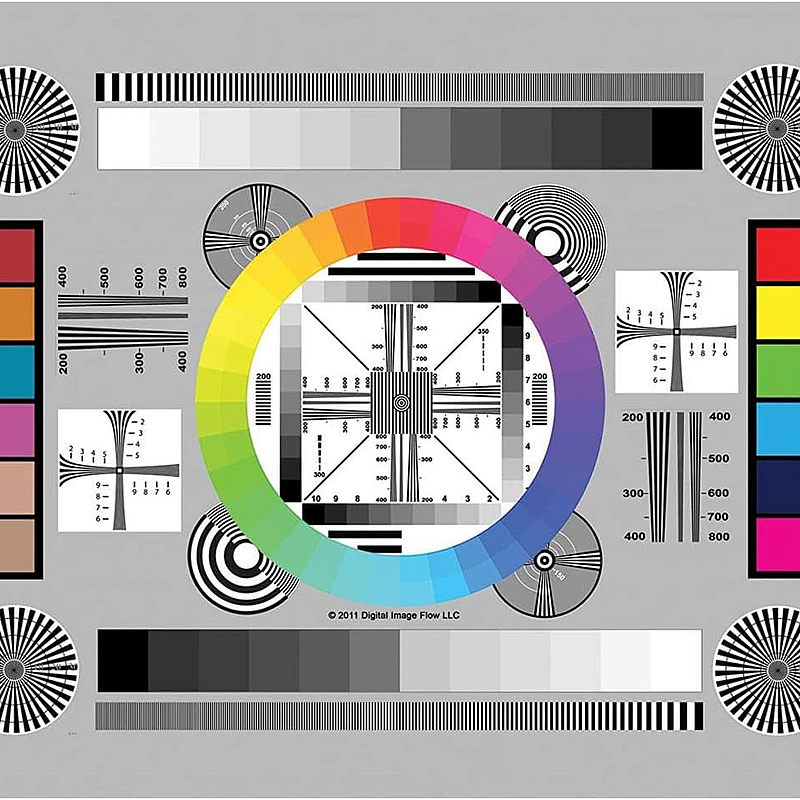
There is a strange, clinical sickness in modern photography culture, and you can usually find it living inside a test chart.
We’ve all seen the reviews. Some guy locks a camera onto a massive tripod, fires a dozen identical frames at a giant grid of lines, and then spends three thousand words analyzing the extreme microscopic corners of a flat plane. It is an exhaustive, exhausting exercise that treats a piece of optical glass like a medical instrument rather than an artistic tool.
If your life’s passion is photographing a single brick in the exact center of a brick wall, and your ultimate artistic goal is ensuring that the bricks at the far edges of the frame are equally sharp, then by all means, live and die by those charts. They are your bible.
But for the rest of us who shoot in the real world, those charts are completely useless.
Real life doesn't happen on a flat, two dimensional plane. Real photography relies on depth, dimension, and background separation. The second you introduce even a minimal amount of separation between your subject and the background, edge to edge chart metrics evaporate. If you are shooting a fast prime wide open, the edges and corners of your frame are supposed to be out of focus. That is the entire physics of a shallow depth of field. Why are we judging a lens by how sharp an area is that will ultimately be rendered as a smooth blur?
Even the classic counterargument the landscape photographer who demands edge to edge perfection, fails the reality check. How often is someone shooting a sprawling mountain vista wide open at f1.4 or 1.0? They aren't. They stop the lens down to 5.6 or 8, at which point the optical physics change entirely, the edges come roaring in, and the performance gap between a multi thousand dollar piece of glass and the budget competitor narrows to almost nothing.
Yet, some obsess over these numbers to justify a specific kind of cognitive dissonance; brand loyalty.
We see it constantly with premium, high end systems. There is a specific class of shooter who will blindly defend their brand of choice, convinced that because they paid a premium, their glass is flawless and utterly incomparable to anything else. It is a defense mechanism designed to protect three things; your wallet, your ego, and your self image as a serious photographer.
The cold truth is that brand loyalty affects your finances and your pride, but it doesn't do a damn thing for your actual image quality.
When you look at real world scenarios instead of test patterns, the metric that actually matters isn't corner resolution, it's rendering. It's center sharpness, contrast, and the transition from the tack sharp focus point to the out of focus background.
If you put them on a test chart, the purists will squeal about the differences. But if you take them out into the world shoot them at a shared aperture like 1.4, and look at the actual images, a fascinating paradox emerges, it becomes legitimately difficult to tell them apart.
Strip away the color, and the gap shrinks even further. The micro contrast, the detail resolved in fine textures, and the 3D pop of the subject separating from the background are trading blows frame for frame. In fact, when you nail the focus on a real world subject, the lens that costs a fraction of the price can easily match or even visually edge out the premium standard.
Then there is the whole obsession with chromatic aberration, the ugly purple fringing that crops up along high contrast edges when shooting wide open. Reviewers love to pan lenses that show it, and to be fair, seeing a magenta outline around every backlit tree branch is an annoying distraction. Eliminating it is a massive engineering win for highly corrected, expensive lenses. But context is everything. If you happen to be shooting on a dedicated monochrome body like a Leica Monochrom, chromatic aberration loses its teeth. Without a color filter array to split the spectrum, that purple fringe simply transforms into a microscopic shift in edge contrast. If there is no color in your workflow to begin with, paying a 4x premium just to fix a color artifact becomes completely pointless. Not to mention, software can correct this as well.
This isn't to say high end lenses don't have value. Real value in a lens review should focus on the holistic picture. The materials, the build quality, long term reliability, and serviceability. There is genuine peace of mind in a beautifully machined, compact tool built to last a lifetime. But that is a discussion about ergonomics, manufacturing, and luxury not the final image.
A good lens review shouldn't be a laboratory data sheet. It should act as a sanity check for the buyer. If a review doesn't help you understand how a lens performs when you're interacting with the world, it isn't a review at all. It's just marketing disguised as mathematics. This is why most of the reviews I write, if not all focus on real world usage and not the scientific lab data you get from so many others. Stop looking at the corners of a flat map, look at how the glass actually renders life, and buy for the image, not the badge.
Here is the Nokton version. For me the only visible difference is that by stopping the Nokton down to 1.4, the aperture blades come into view and the edges can now be seen in the background bokeh balls.
No comparison here. But this was shot with a 35mm Distagon which is arguably the best 35 you can get on an M. However, the Summilux FLE version will be very similar at 3x the cost of the Zeiss. But even again, My focus was the chef's face and not the edges.
On a side note, reviews should also include information about handling and ergonomics. In this case, if you prefer a smaller lens, the FLE will be a better choice for you as the Distagon is considerably larger. However, once again, any chart and edge to edge comparison will be meaningless here other than to say, you can shoot this lens fairly open and get edge to edge sharpness. Does that really matter in this scene?
At the end of the day, a lens is just a conduit for light, not a receipt to be flaunted or a math problem to be solved. The best reviews understand that photography is an emotional pursuit, and the best glass is simply the one that gets out of your way and delivers the look you want. Save your money, trust your eyes, and leave the bricks to the builders.
Use formatting shortcuts: [b]bold[/b], [i]italics[/i], [quote]quote[/quote], or [url=https://site.com]links[/url]. Paste a direct photo URL (.jpg, .png, .webp) or video link to embed it instantly.
Post
Reset/Cancel
Get your store banner on LeicaImages.com Send us an email to support@leicaimages.com
Follow @leicaimages
Daily community photo highlights, serial registry alerts, and site updates.
Support LeicaImages.com — Our community is free for everyone. If you value what we do, you can help cover our server and development costs with a small one time or monthly donation.




On a side note, reviews should also include information about handling and ergonomics. In this case, if you prefer a smaller lens, the FLE will be a better choice for you as the Distagon is considerably larger. However, once again, any chart and edge to edge comparison will be meaningless here other than to say, you can shoot this lens fairly open and get edge to edge sharpness. Does that really matter in this scene?