 Voigtlander 28mm f/1.5 Type II Nokton Review: Why this M mount lens rules for travel and anything else.
Yes. I know, it’s been out on the market for a little while now and this review may be late, but the
Voigtlander 28mm f/1.5 Type II Nokton more than warrants a fresh look. In an era dominated by super engineered autofocus lenses and massive mirrorless zooms, the 28mm f/1.5 Nokton reminds me of why shooting with a manual focus rangefinder setup with my Leica M11 is an absolute joy.
First things first. No Brick Walls Here
Before we dive into this, let's establish one ground rule. This review, like all my others, is rooted entirely in real world use scenarios.
Let’s be honest with ourselves, how often do you actually photograph flat brick walls, crop in to 400% on a digital sensor, and obsess over extreme corner sharpness? In actual practice, photography is dynamic. Most of the time, we lock onto a subject, compose our frame, and let the rest of the scene fall into its natural depth of field. This review reflects how the lens actually performs when you're out in the wild, dealing with shifting light, moving subjects, and spontaneous moments.
Whether you are packing light for a multi country excursion or pounding the pavement for street photography, this lens punches way above its weight class. Let’s dive into why this this little Nokton needs a permanent spot in your bag like it has in my own bag.
Build, aesthetics, and handling on Leica
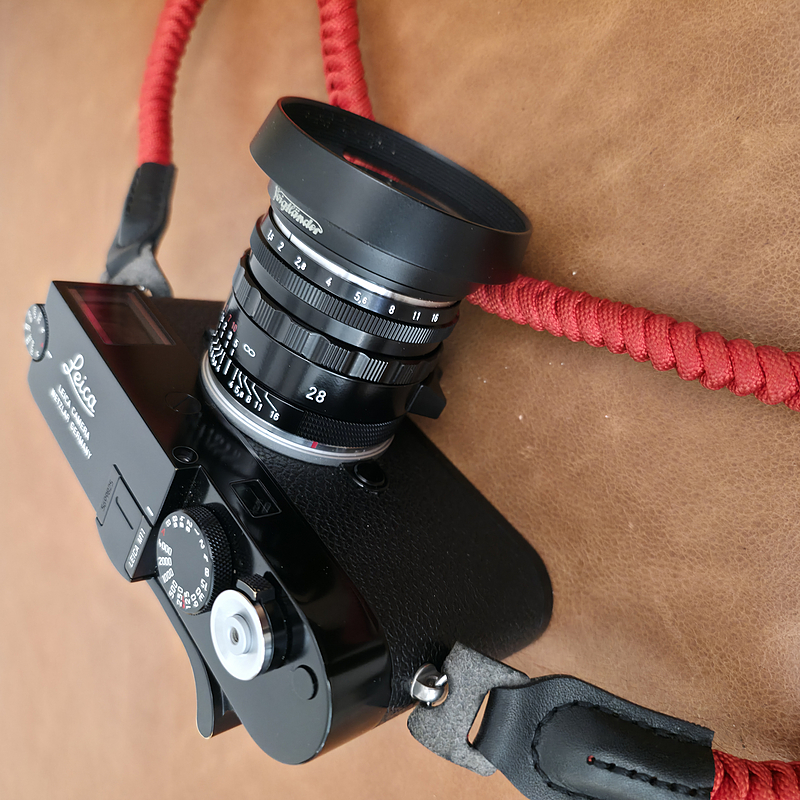
Let’s address the elephant in the room. I hate to say it. But, aesthetics matter in the Leica ecosystem. The Voigtlander 28mm f/1.5 Type II is available in a few finishes, but when paired with either a classic black paint Leica M11 or the striking Leica M11-P Safari in green, it looks right at home almost as if it rolled straight out of the factory together with the camera as a kit.
I personally own the Type II in glossy black and I find the look is amazing. Right there with my Classic re-issue 50 Summilux in black glossy paint. I only wish the hood was glossy too.
Voigtlander 28
Leica classic re-issue

The Type II version features a traditional scalloped focusing tab, offering that mechanical feedback we look for in m mount lenses. The build quality is all metal (brass), tight, and reassuringly dense without feeling front heavy. It balances seamlessly, making it a natural extension of my hand during long days of walking.
Diverse conditions and shooting styles
A lens can look gorgeous on a shelf, but how does it perform when you're navigating crowded alleyways, sudden shifts in light, and spontaneous street moments?
In a word, flawless.
Although, the 50 is still my favorite focal length followed by the 35, the 28mm focal length is arguably the king of travel and documentary storytelling. It gives you enough width to capture the grand scale of architecture or a sprawling market square, yet remains intimate enough to pull viewers right into the scene without the exaggerated distortion of a 21mm or wider.
To really test its capabilities, I put the lens through its paces across vastly different conditions and shooting styles from spontaneous street portraits and moody night scenes to zone focused foot traffic and close up detail work.
- Street portraits Shooting near or wide open at f/1.5 provides a gorgeous, 3D falloff that separates subjects from the background. Whether capturing a candid look on a side street or a quiet moment waiting at an outdoor cafe, the lens delivers incredible intimacy.
- Low light & night scenes Shooting in low light or late evening at sidewalk tables and downtown storefronts. As you will see in the samples posted below, shooting wide open at f/1.5 pulls in ample ambient light to keep shutter speeds high. It locks onto details like a dog's fur or a passerby's expression with striking sharpness while background lights dissolve into smooth bokeh.
- Zone focusing Stopping down to f/5.6 or f/8 lets you pre focus the distance for fast paced places. When done right, this style yields results similar to auto focus. It's how it was done originally by the old timers.
- Close up texture & detail Pushing the lens wide open up close reveals surprising versatility. Focusing on intimate subjects from a house plant indoors to rusty bicycle handlebars, delicate spider webs, or a scarecrow's smile outdoors shows razor sharp focus planes alongside smooth and beautiful background falloff.
- Casual moments Even on a lazy afternoon pointing the camera at a pair of propped up feet from a chair, the optics deliver crisp perspective and texture.
Rendering and sharpness wide open to f/2
If you buy a fast f/1.5 prime, you want to know how it performs when you push it to its limits. Rest assured, the rendering here is nothing short of gorgeous.
- Wide open at f/1.5 Unlike many vintage styled fast primes that turn into a hazy, glowing mess wide open, the Nokton delivers a surprising punch in the focal plane while rolling off into a smooth three dimensional fall off. It creates incredible subject separation that you simply don’t expect from a 28mm lens.
- Stopped from f/2 to f/5.6 By the time you hit f/2, the lens sharpens up dramatically. As the sample images demonstrate, it is tack sharp on your actual subject, resolving intricate textures, micro contrast, and wide landscapes with clarity that brings digital files to life.
Ok, here we go. Lets start analyzing some images. Again, nothing special. Jut trying to show what the lens is capable under different shooting conditions.





Guest wrote:
I have nokton 50 1.1 , ultron 35 1.7 (stunning), and older (ultron?) 28 1.8. (and rigid summicron 50 2) Capable enough for me. If choosing one, then the 35mm.
I hear you. The 35 is a fantastic focal length and is a perfect fit between wide and short telephoto. I was just so surprised as to how well this 28 Nokton performed. Although to be honest, My next trip will be my Distagon 35 and 75 apo Summicron.
Guest wrote:
Very nice review. I think my Zeiss 28 f2.8 is in no way inferior. The f stop difference is unimportant for my kind of shooting and with excellent high ISO available on newer cameras irrelevant.
I can't argue with that. But for me, I like the extra 2 stops and the close focus capabilities of the Nokton which helps me mimic a 35 or 50 when it comes to portraits and bokeh. Like in this images.