Why This Isn't Just Another Rant About Social Media.
I could write a traditional, clinical breakdown discussing how the mainstream web is actively degrading the photographic arts, but dry statistics don’t capture the reality of what we are losing. Photography is a visual discipline. It’s about the physical weight of a camera, the patience required to read a street, and the quiet spaces where an image is actually left alone to speak for itself. To understand why modern, algorithmic based platforms are fundamentally toxic to real photography communities, you have to look at it through the eyes of someone who actually lives the craft every day. As a retired person ( as of April 1st ) with lots of time on my hands, I think I fit this description pretty well. That is why I want to share a snapshot of a recent trip I took across the river into Portland. It started as a routine morning, but it ended up perfectly framing the exact war currently being waged between AI and the human eye.
With that said .....
I was scrolling through Instagram the other day on my phone when it finally hit me. A while back, I set up an account there thinking it’d be a decent way to connect with other real photographers and maybe drive a little traffic over to my sites like leicaimages.com and 50mil.com. But lately, every time I log on, I realize the stuff filling my screen isn't even close to what I want to look at, let alone share. It’s become this brainless dumping ground where anyone with a smartphone or a text prompt can just flood the grid with absolute junk. I closed the app for what felt like the hundredth time, staring at the screen with that same recurring thought echoing in my head. What the hell am I even doing here? None of this garbage is real photography. I leaned back in my chair, reached over, and picked up my M11.
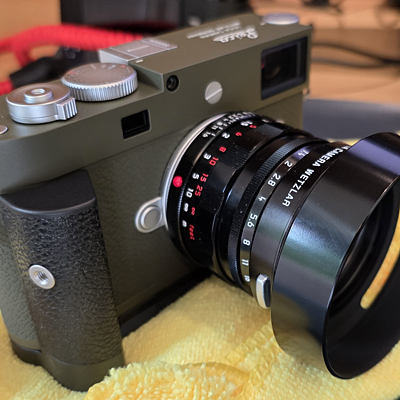
Feeling the cold weight of that camera in my hands always grounds me. It’s real metal, real glass, and it doesn't try to do the thinking for me. It makes photography enjoyable. Plus it's like super bling when it's hanging around your neck.
Fast forward to the next day. I actually had a plan for the day. I woke up, the house still freezing. The wife won't let me put the heater on. Typical bossy attitude. The weather here in Washington state can get pretty hot during the summer days, but the evenings and early mornings still carry that deep chill. I grabbed a jacket, checked that the battery in my camera had a decent charge, and walked out the door with every intention of heading straight into Portland.
The air outside was crisp, but it felt good. Out here where I live, in the sticks, there wasn't any traffic to deal with, just the occasional deer crossing the road. But what I figured would be an early start to a quick trip ended up turning into a much longer venture than I originally planned. I had to get gas, then I decided to stop for some breakfast, gotta have that sausage egg mcmuffin and then I made a spontaneous detour to Best Buy out near the airport just to look at some laptops. That set me back a bit, especially since I got there early and had to sit in the car for a little while waiting for the store doors to open. Needless to say, by the time I finally hit I-84 into Portland, the weather had completely shifted. I was actually a bit disappointed to find bright, harsh lighting on a rare sunny day. I much prefer overcast skies. Give me those flat, gray days every time for that beautiful, even lighting.
I parked my 4runner near Burnside and 10th and stepped out into a bright sunny day. I knew the conditions was going to make exposing for the highlights a total pain. It was exactly the kind of direct, unforgiving light that modern smartphone sensors absolutely choke on, forcing their software to aggressively HDR the crap out of the scene until it looks like a flat, crappy rendering. But for me, a different story, real photography. No digital filters, no algorithms smoothing out the edges, no AI pretending to be art. Just raw captures of a various moments throughout the city. The exact kind of images I’d be excited to upload to leicaimages.com or purerangefinder.com, miles away from the mindless noise of Instagram.
Standing there on the pavement, watching people walk by with their phones held out like electronic divining rods, I realized something even more sinister. Instagram hasn’t just ruined the images themselves, it has completely destroyed any real sense of a photography community online. It’s turned what used to be a shared artistic discipline into a high speed slot machine, a mindless game where success is measured in three second attention spans, artificial views, and cheap double taps. The platform’s code doesn’t care about a carefully composed photograph, or how your eye is led subtly to the upper corner of an image. It rewards loud, oversaturated, instant gratification garbage, mountain ranges dipped in radioactive candy, or fake AI portraits of gritty men in the rain that looks just passable enough on a screen the size of a deck of cards to keep people scrolling. It has completley stripped away the soul of the community, replacing real human interactions with bot accounts and mindless emojis. There’s no appreciation left for the sweat a photographers puts in to grab that shot. It's just AI pretending to have a pulse, and it has left true enthusiasts like myself completely homeless on the mainstream web.
Walking back to my 4runner later that afternoon, I couldn't wait to get back across the river, sit down at my desk, and escape the whole mainstream digital mess. Back home in the quiet of my spare bedroom office, I pulled up my bookmarks purerangefinder.com , leicaimages.com, and 50mil.com. I created these sites, hence the shameless plugs. But for the broader forum community and general photography discussions, I usually head over to a few of the last safe spaces on the net, www.fredmiranda.com and www.rangefinderforum.com which I also built way back in the day. Wow. I am really dating myself here.
The relief was instant. The interface on these niche sites isn't flashy. There are no auto playing video reels, no targeted ads, and no algorithmic feed trying to exploit my psychological vulnerabilities. It’s just a clean, quiet gallery framed against a deep, neutral dark background which lets the white balance of an image actually stand out without blinding you.
I clicked into my favorites feed located here https://leicaimages.com/favorite-photos/1 and started scrolling. The difference was like walking out of a noisy casino in Vegas and into a quiet gallery. There are no endless forum directories with a hundred confusing categories to sift through here. The photograph is the sole focus, and any conversation here is built directly around the photo itself.
Feel free to browse the work of some of my favorites photographers on LeicaImages. You will soon discover why there needs to be a hard distinction between the senseless garbage on Instagram destroying photography, and the real art like the samples you'll find in the links below.
I just stared at it for a minute. It was a tight, heavy B&W portrait of an older man on the street holding a cardboard sign, captured with a Leica camera. The rendering was spectacular. Every single detail in his weathered face, the deep lines around his eyes, and the stray, coarse hairs of his beard were razor sharp and structural. This wasn't some artificial, smooth skin portrait generated by an AI prompt or beautified by a smartphone lens. You could practically feel the rough texture of the cardboard and the brickwork behind him.
The range of tones in the shot was exactly what makes real photography a true discipline. The highlights on his forehead and the bridge of his nose were bright but completely honest, not clamped down by some aggressive HDR software trying to force a uniform look. And the shadows? They were allowed to be dark, deep, and full of mystery. Instagram’s algorithm would have choked on a scene like this. it would have tried to lift the shadows until they looked muddy and flat, or smoothed out his skin until he looked like a plastic mannequin. But here on a clean, neutral dark gallery page, the image just tsnads out. There are no flashing icons or vertical video reels competing for my attention. It was just an uncompromised, human moment captured through real glass on a Leica.
In closing, I would like to say, Look, I get it. Instagram has its place. I actually enjoy some of thos funny short videos. If you want to share a casual snapshot of your lunch, a quick video reel of your vacation, or keep up with family, the features are fine for that. It’s built for a massive, general audience. But let me be entirely clear, it is absolutely not suited for photographers who are looking for genuine, real interaction with other photographers and critics who actually understand the craft. When you mix mindless, daily moment grabbing snapshots with intentional art, the art completely loses its context. This is exactly why niche communities matter. On sites like leicaimages.com, purerangefinder.com, and 50mil.com, you don't lose any of the utility. You can still comment, you can still like, and you can still share photos to help promote your work. The massive difference is the foundation. Here, those activities aren't driven by an invisible algorithm engineered to exploiit your attention span. They are driven by real human beings having actual conversations rooted in real photography, composition, lighting, and interaction.
Independent photography sites and niche galleries across the web offer these exact same community tools to share our passion, but without the baggage. We still have likes, comments, and portfolios, but we keep the AI garbage and the mindless snapshot clutter out of the mix entirely. The difference is purpose. Let's give each other something truly worth discussing.
Use formatting shortcuts: [b]bold[/b], [i]italics[/i], [quote]quote[/quote], or [url=https://site.com]links[/url]. Paste a direct photo URL (.jpg, .png, .webp) or video link to embed it instantly.
Support LeicaImages.com — Our community is free for everyone. If you value what we do, you can help cover our server and development costs with a small one time or monthly donation.





I could write a traditional, clinical breakdown discussing how the mainstream web is actively degrading the photographic arts, but dry statistics don’t capture the reality of what we are losing. Photography is a visual discipline. It’s about the physical weight of a camera, the patience required to read a street, and the quiet spaces where an image is actually left alone to speak for itself. To understand why modern, algorithmic based platforms are fundamentally toxic to real photography communities, you have to look at it through the eyes of someone who actually lives the craft every day. As a retired person ( as of April 1st ) with lots of time on my hands, I think I fit this description pretty well. That is why I want to share a snapshot of a recent trip I took across the river into Portland. It started as a routine morning, but it ended up perfectly framing the exact war currently being waged between AI and the human eye.
With that said .....
I was scrolling through Instagram the other day on my phone when it finally hit me. A while back, I set up an account there thinking it’d be a decent way to connect with other real photographers and maybe drive a little traffic over to my sites like leicaimages.com and 50mil.com. But lately, every time I log on, I realize the stuff filling my screen isn't even close to what I want to look at, let alone share. It’s become this brainless dumping ground where anyone with a smartphone or a text prompt can just flood the grid with absolute junk. I closed the app for what felt like the hundredth time, staring at the screen with that same recurring thought echoing in my head. What the hell am I even doing here? None of this garbage is real photography. I leaned back in my chair, reached over, and picked up my M11.
Feeling the cold weight of that camera in my hands always grounds me. It’s real metal, real glass, and it doesn't try to do the thinking for me. It makes photography enjoyable. Plus it's like super bling when it's hanging around your neck.
Fast forward to the next day. I actually had a plan for the day. I woke up, the house still freezing. The wife won't let me put the heater on. Typical bossy attitude. The weather here in Washington state can get pretty hot during the summer days, but the evenings and early mornings still carry that deep chill. I grabbed a jacket, checked that the battery in my camera had a decent charge, and walked out the door with every intention of heading straight into Portland.
The air outside was crisp, but it felt good. Out here where I live, in the sticks, there wasn't any traffic to deal with, just the occasional deer crossing the road. But what I figured would be an early start to a quick trip ended up turning into a much longer venture than I originally planned. I had to get gas, then I decided to stop for some breakfast, gotta have that sausage egg mcmuffin and then I made a spontaneous detour to Best Buy out near the airport just to look at some laptops. That set me back a bit, especially since I got there early and had to sit in the car for a little while waiting for the store doors to open. Needless to say, by the time I finally hit I-84 into Portland, the weather had completely shifted. I was actually a bit disappointed to find bright, harsh lighting on a rare sunny day. I much prefer overcast skies. Give me those flat, gray days every time for that beautiful, even lighting.
I parked my 4runner near Burnside and 10th and stepped out into a bright sunny day. I knew the conditions was going to make exposing for the highlights a total pain. It was exactly the kind of direct, unforgiving light that modern smartphone sensors absolutely choke on, forcing their software to aggressively HDR the crap out of the scene until it looks like a flat, crappy rendering. But for me, a different story, real photography. No digital filters, no algorithms smoothing out the edges, no AI pretending to be art. Just raw captures of a various moments throughout the city. The exact kind of images I’d be excited to upload to leicaimages.com or purerangefinder.com, miles away from the mindless noise of Instagram.
Standing there on the pavement, watching people walk by with their phones held out like electronic divining rods, I realized something even more sinister. Instagram hasn’t just ruined the images themselves, it has completely destroyed any real sense of a photography community online. It’s turned what used to be a shared artistic discipline into a high speed slot machine, a mindless game where success is measured in three second attention spans, artificial views, and cheap double taps. The platform’s code doesn’t care about a carefully composed photograph, or how your eye is led subtly to the upper corner of an image. It rewards loud, oversaturated, instant gratification garbage, mountain ranges dipped in radioactive candy, or fake AI portraits of gritty men in the rain that looks just passable enough on a screen the size of a deck of cards to keep people scrolling. It has completley stripped away the soul of the community, replacing real human interactions with bot accounts and mindless emojis. There’s no appreciation left for the sweat a photographers puts in to grab that shot. It's just AI pretending to have a pulse, and it has left true enthusiasts like myself completely homeless on the mainstream web.
Walking back to my 4runner later that afternoon, I couldn't wait to get back across the river, sit down at my desk, and escape the whole mainstream digital mess. Back home in the quiet of my spare bedroom office, I pulled up my bookmarks purerangefinder.com , leicaimages.com, and 50mil.com. I created these sites, hence the shameless plugs. But for the broader forum community and general photography discussions, I usually head over to a few of the last safe spaces on the net, www.fredmiranda.com and www.rangefinderforum.com which I also built way back in the day. Wow. I am really dating myself here.
The relief was instant. The interface on these niche sites isn't flashy. There are no auto playing video reels, no targeted ads, and no algorithmic feed trying to exploit my psychological vulnerabilities. It’s just a clean, quiet gallery framed against a deep, neutral dark background which lets the white balance of an image actually stand out without blinding you.
I clicked into my favorites feed located here https://leicaimages.com/favorite-photos/1 and started scrolling. The difference was like walking out of a noisy casino in Vegas and into a quiet gallery. There are no endless forum directories with a hundred confusing categories to sift through here. The photograph is the sole focus, and any conversation here is built directly around the photo itself.
Feel free to browse the work of some of my favorites photographers on LeicaImages. You will soon discover why there needs to be a hard distinction between the senseless garbage on Instagram destroying photography, and the real art like the samples you'll find in the links below.
Steve Mark
Jeremy Rata
Cancan
I stopped scrolling when I hit this picture taken by Steve Mark.
You can view the larger version and complete details here: https://www.leicaimages.com/photo/400546
I just stared at it for a minute. It was a tight, heavy B&W portrait of an older man on the street holding a cardboard sign, captured with a Leica camera. The rendering was spectacular. Every single detail in his weathered face, the deep lines around his eyes, and the stray, coarse hairs of his beard were razor sharp and structural. This wasn't some artificial, smooth skin portrait generated by an AI prompt or beautified by a smartphone lens. You could practically feel the rough texture of the cardboard and the brickwork behind him.
The range of tones in the shot was exactly what makes real photography a true discipline. The highlights on his forehead and the bridge of his nose were bright but completely honest, not clamped down by some aggressive HDR software trying to force a uniform look. And the shadows? They were allowed to be dark, deep, and full of mystery. Instagram’s algorithm would have choked on a scene like this. it would have tried to lift the shadows until they looked muddy and flat, or smoothed out his skin until he looked like a plastic mannequin. But here on a clean, neutral dark gallery page, the image just tsnads out. There are no flashing icons or vertical video reels competing for my attention. It was just an uncompromised, human moment captured through real glass on a Leica.
In closing, I would like to say, Look, I get it. Instagram has its place. I actually enjoy some of thos funny short videos. If you want to share a casual snapshot of your lunch, a quick video reel of your vacation, or keep up with family, the features are fine for that. It’s built for a massive, general audience. But let me be entirely clear, it is absolutely not suited for photographers who are looking for genuine, real interaction with other photographers and critics who actually understand the craft. When you mix mindless, daily moment grabbing snapshots with intentional art, the art completely loses its context. This is exactly why niche communities matter. On sites like leicaimages.com, purerangefinder.com, and 50mil.com, you don't lose any of the utility. You can still comment, you can still like, and you can still share photos to help promote your work. The massive difference is the foundation. Here, those activities aren't driven by an invisible algorithm engineered to exploiit your attention span. They are driven by real human beings having actual conversations rooted in real photography, composition, lighting, and interaction.
Independent photography sites and niche galleries across the web offer these exact same community tools to share our passion, but without the baggage. We still have likes, comments, and portfolios, but we keep the AI garbage and the mindless snapshot clutter out of the mix entirely. The difference is purpose. Let's give each other something truly worth discussing.